Humanitarian Action and Ethics by Ayesha Ahmad James Smith
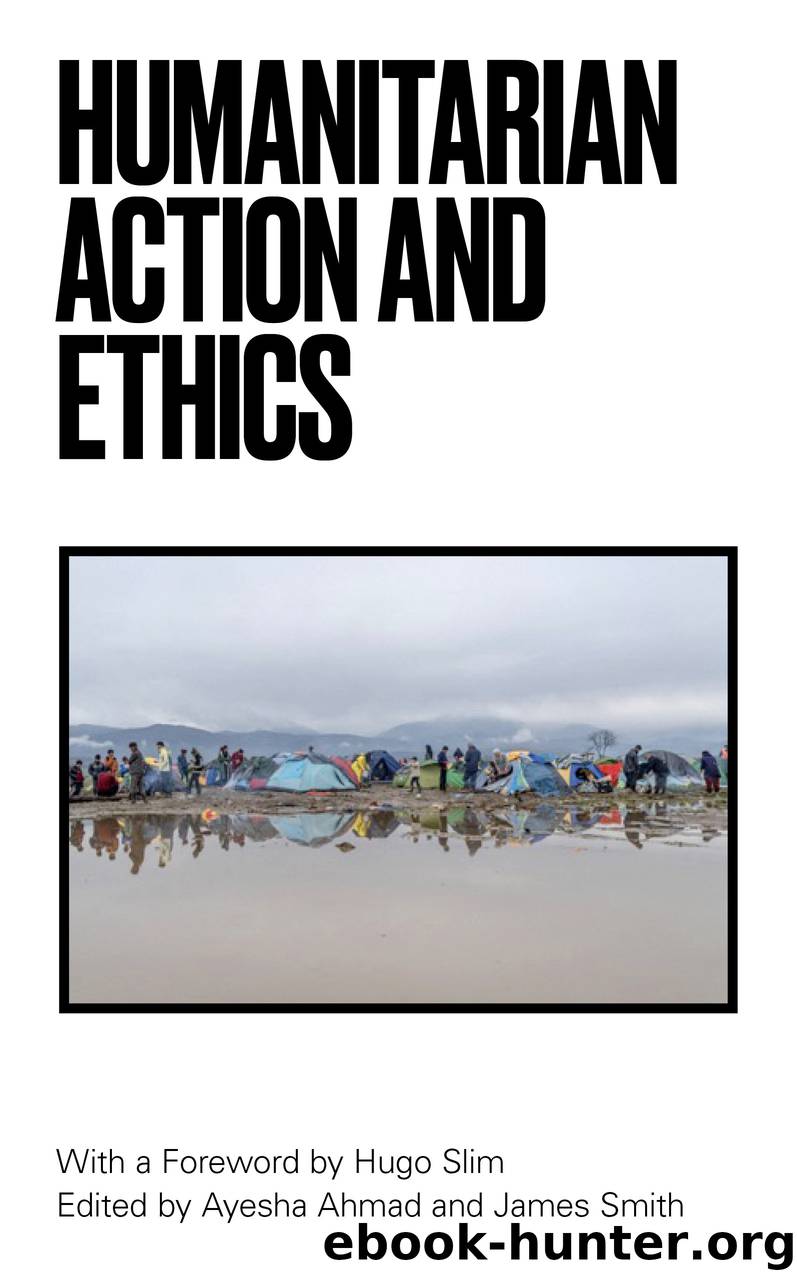
Author:Ayesha Ahmad,James Smith
Language: eng
Format: epub
ISBN: 9781786992703
Publisher: Book Network Int'l Limited trading as NBN International (NBNi)
Published: 2018-04-18T16:00:00+00:00
10 | THE EMERGENCE OF HUMANITARIAN FAILURE: THE CASE OF HAITI
Jan Wörlein
Introduction
The aftermath of the fatal 2010 Haiti earthquake disaster has been described as a period of the largest and most dense deployment of humanitarian relief since the emergence of the international humanitarian system (Verlin, 2014). The January 2010 7.0-magnitude earthquake, followed by a multiplicity of crises including the cholera epidemic, Hurricanes Sandy and Matthew, two electoral crises, and widespread drought, has resulted in an unprecedented influx of humanitarian actors to the country. The Haitian case is also seen as the archetype of what has been called ‘humanitarian failure’: the narrative of a humanitarian system failing to deliver aid in an efficient way (Karunakara, 2010; Farmer et al., 2012; Katz, 2013; Thomas, 2013; Biquet, 2014). This narrative of failure was not exclusively an external criticism, but was also widespread among humanitarian workers themselves (Binder, 2013). Even though the criticisms of inefficient aid are legitimate some of the underlying ethical challenges to the idea of humanitarian failure are rarely put forward. As Binder (2013) points out the idea of a humanitarian failure tells us more about failed expectations of a humanitarian system, than about its actual performance. This chapter offers for that reason an analysis of the conditions under which those expectations appear, to contextualise ethical debates about aid failure.
The ‘humanitarian world’ (Revet, 2011) became increasingly professionalised and institutionalised during the 1980s and 1990s, with growing ‘competition and division of labor’ (Dauvin & Siméant, 2002). This ‘world’ is today repeatedly confronted by the phenomena that the Haitian case crystallises: a great fluidity of actors in the ‘field’ as a result of short-term contracts; rapid turnover between headquarters and the ‘field’; varying affiliations between different types of organisations as a result of consultancy contracts; and insecure working conditions (Schneiker, 2015).
For this reason, this chapter proposes to analyse the professional practice of humanitarian response in Haiti between 2010 and 2015 with the assumption that the fluidity of aid to Haiti is as much an obstacle as a resource for local agents. My focus is specifically the way in which crisis management actors in Haiti (re)produce the conditions of their actions using elements of their fragmented and changing environment. This will show how actors cope with the ethical dilemma of engaging in a system which they partially perceive as immoral.
For an Open Definition of Aid Actors and Aid
In contrast with functionalist and normative approaches that focus on failure, I seek to study the reasons why aid actors perceive themselves as part of the failure of the humanitarian system in Haiti. For this reason, I will refrain from proposing an external definition of such a humanitarian system in disarray, because those definitions tend to narrow the debate to efficient aid rather than open it to a historical but local perspective. I will rather conceptualise the humanitarian space in Haiti as defined and structured by its actors, and thus draw on Atlani-Duault and Dozon’s (2011) anthropological perspective:
humanitarian aid now simply defines activities which groups claim as
Download
This site does not store any files on its server. We only index and link to content provided by other sites. Please contact the content providers to delete copyright contents if any and email us, we'll remove relevant links or contents immediately.
| Anthropology | Archaeology |
| Philosophy | Politics & Government |
| Social Sciences | Sociology |
| Women's Studies |
The Secret History by Donna Tartt(19088)
The Social Justice Warrior Handbook by Lisa De Pasquale(12190)
Thirteen Reasons Why by Jay Asher(8910)
This Is How You Lose Her by Junot Diaz(6887)
Weapons of Math Destruction by Cathy O'Neil(6280)
Zero to One by Peter Thiel(5802)
Beartown by Fredrik Backman(5754)
The Myth of the Strong Leader by Archie Brown(5507)
The Fire Next Time by James Baldwin(5446)
How Democracies Die by Steven Levitsky & Daniel Ziblatt(5218)
Promise Me, Dad by Joe Biden(5153)
Stone's Rules by Roger Stone(5088)
A Higher Loyalty: Truth, Lies, and Leadership by James Comey(4964)
100 Deadly Skills by Clint Emerson(4925)
Rise and Kill First by Ronen Bergman(4789)
Secrecy World by Jake Bernstein(4753)
The David Icke Guide to the Global Conspiracy (and how to end it) by David Icke(4720)
The Farm by Tom Rob Smith(4511)
The Doomsday Machine by Daniel Ellsberg(4490)
